
Why Gutters Matter More Than They Get Credit For
Gutters look like a minor accessory bolted to the edge of a house, but they're doing real structural work. A roof without functioning gutters dumps thousands of gallons of water a year straight down the fascia and into the flower beds next to the foundation. Across Leander, Cedar Park, and the rest of Central Texas, that water load shows up fast during spring storms and again in the shorter, heavier bursts that roll through in late summer.
Homeowners tend to notice gutters only when something's visibly wrong, a sag, a waterfall over the side, a puddle by the back door. By the time it's visible, the fascia board behind the gutter has often already been wet for months. A twice-a-year check catches the quiet failures before they become expensive ones.
What Actually Causes a Gutter System to Fail
Gutter failure almost never happens all at once. It's a slow accumulation of small problems, a loose hanger here, a clogged downspout there, until the whole system stops doing its one job: moving water off the roof and away from the house.
Pitch and Hangers
A gutter run needs a slight, consistent slope toward its downspouts. When hangers loosen or a section sags, water pools instead of draining, adding weight that stresses the remaining hangers further. Over a few seasons that sag gets worse, especially where a tree branch or ladder has put pressure on one section.
Standing water in a sagging gutter also attracts mosquitoes and accelerates rust on steel gutters or corrosion at aluminum seams. Checking that water drains fully within a minute or two of a hose test is one of the simplest ways to catch a hanger problem before it becomes a full section replacement.
Seams, End Caps and Downspout Connections
Seamless gutter sections still have joints at corners, end caps, and downspout outlets, and those joints are sealed, not welded. The sealant dries out and cracks with Texas heat cycles, which opens a gap that drips water straight down the siding instead of into the trough.
Downspouts clog at the elbow more often than anywhere else, especially where a downspout turns to route water away from a walkway. A downspout that's running slow or backing up at the top usually has a blockage at that first bend, not deeper in the pipe.
| Without Gutter Guards | With Gutter Guards | Still True Either Way |
|---|---|---|
| Cleared 2-4 times a year depending on tree cover | Cleared 1-2 times a year for fine debris | Downspouts need separate clearing |
| Full leaf and debris load collects in trough | Leaves shed off the guard, fine grit still passes through | Seams and hangers still age the same |
| Easier to spot standing water during inspection | Harder to see trough condition without lifting guard | Pitch still needs to be checked twice a year |
What a Gutter System Is Actually Protecting
A gutter's job starts at the roof edge. It catches runoff coming off the shingles or metal panels, channels it along the trough, and routes it down through downspouts to a point away from the foundation. Behind the gutter sits the fascia board, the trim piece that caps the rafter ends and gives the gutter something to hang from.
When a gutter fails and water runs behind it instead of through it, the fascia is the first thing to absorb the damage. Wet fascia wood softens, then rots, and eventually can't hold the gutter hangers at all, which is often how a homeowner discovers the problem, when the whole gutter section comes loose in a storm.
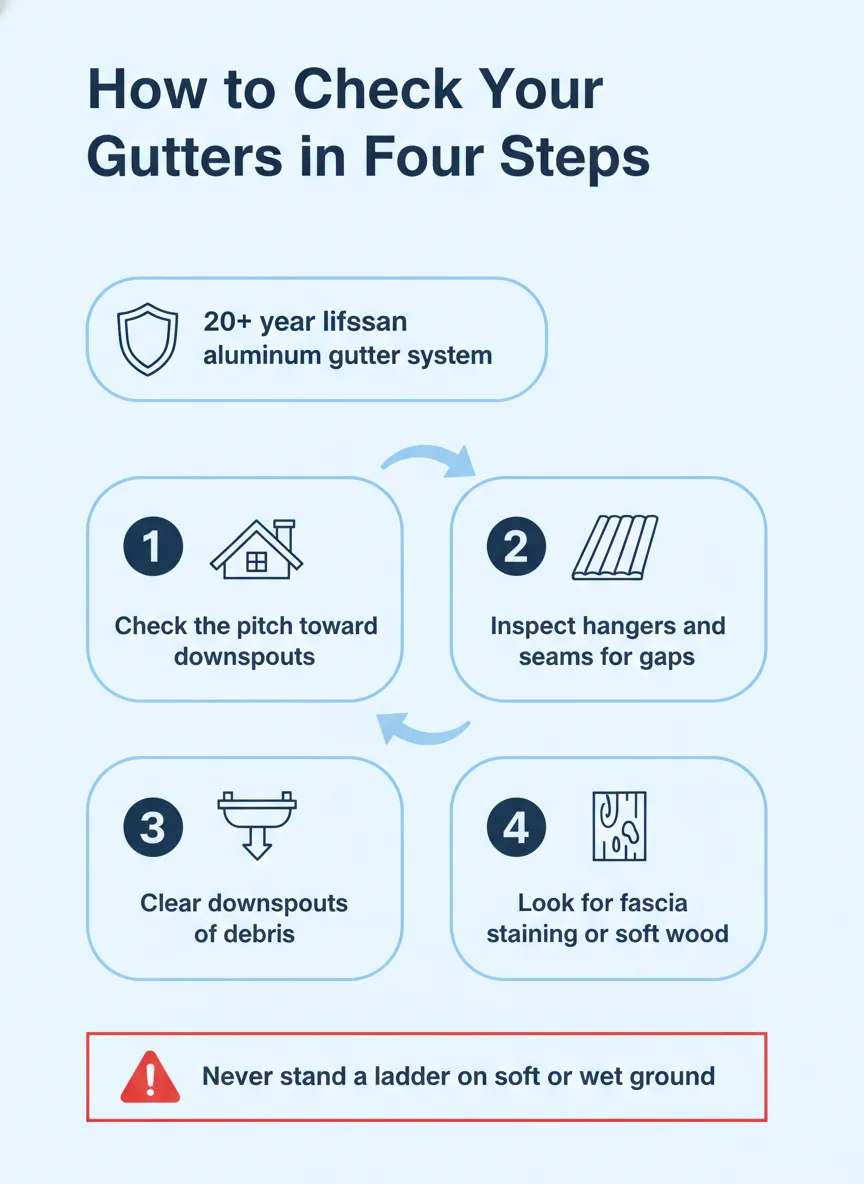
Step-by-step: Checking Your Gutters Twice a Year
This check takes most homeowners under an hour per side of the house and doesn't require getting on the roof itself, just a sturdy ladder and a garden hose.
- Clear visible debris: Scoop out leaves, seed pods, and shingle grit by hand or with a small trowel before testing anything else.
- Run a hose test: Run water at the high end of each gutter run and watch whether it drains fully within a minute or two without pooling.
- Check hanger spacing: Look for hangers that have pulled loose, bent, or spread further apart than the rest of the run.
- Inspect seams and end caps: Look for dried, cracked sealant at joints and corners where water could be dripping through instead of into the trough.
- Clear each downspout: Run water down every downspout separately and confirm it exits freely at the bottom without backing up.
- Check the splash point: Confirm each downspout discharges water at least a few feet from the foundation, not straight against the slab.
- Look at the fascia: Check for staining, soft spots, or peeling paint behind the gutter line, which signals water has already been getting through.
What You'll Find When Something's Already Wrong
If the twice-yearly check turns up a problem, the symptoms usually point pretty clearly to what's failing and how urgent it is.
Fascia Staining and Soft Wood
Dark streaking below the gutter line, peeling exterior paint, or wood that gives slightly when pressed with a thumb all point to trapped moisture behind the gutter. This needs attention before the next heavy rain, since soft fascia won't hold gutter hangers much longer.
In most cases this traces back to a seam or end cap that's been leaking slowly for a season or more. Catching it at the staining stage usually means a repair; waiting until the wood is spongy usually means replacing a section of fascia along with the gutter.
Erosion or Wet Soil Near the Foundation
Mulch washed into a trench pattern, bare soil where grass won't grow, or a consistently damp patch near the foundation after it hasn't rained in days all point to a downspout dumping water in the wrong place. This is worth fixing even if the gutter trough itself looks fine, since the downspout routing is doing the actual damage.
Extending a downspout with an underground drain line or a simple splash block is usually enough to redirect the water away from the slab and stop the erosion pattern from getting worse.
What You Can Check Yourself vs. What Needs a Pro
The twice-yearly debris clearing, hose test, and visual fascia check are reasonable DIY tasks for a homeowner comfortable on a ladder. None of it requires specialized tools, just patience and good footing, and catching a problem early at this stage is the cheapest version of any gutter fix.
Where it gets riskier is working at height on a two-story fascia line, handling sections that are already sagging or partially detached, or diagnosing whether fascia rot has spread into the rafter tails underneath. A section that's pulled loose or wood that's visibly rotted is a job for someone with the right ladder setup and the experience to tell how far the damage has traveled.
It's also worth having a professional look at gutters anytime a roof is being replaced or repaired, since the drip edge, gutter line, and fascia all meet at the same point and get checked together more efficiently than separately. A roof repair visit is a natural time to have the gutter line evaluated as well.
Keeping the Whole Roof Edge in Good Shape
Gutters, fascia, and the roof edge above them work as one connected system, and a problem in one spot tends to show up in the others eventually. A twice-a-year check, done in spring and fall, catches the small failures, the loose hanger, the dried sealant, the slow downspout, before they turn into fascia rot or foundation trouble.
Homeowners in Cedar Park and across the rest of Central Texas dealing with sagging gutters, water tracking down the siding, or gutters that came loose after a storm covered in this storm damage guide can have Total Building Experts Roofing & General Contractor take a look at the gutter line along with the roof itself.
Frequently asked questions
How often should gutters be cleaned in Central Texas?
Most homes in Central Texas need gutters cleared twice a year, once in late spring after oak pollen and seed drop, and again in fall after leaf drop. Homes under heavy tree cover may need a mid-season check too.
Do gutter guards mean I never have to clean my gutters again?
No. Gutter guards reduce the volume of leaves and large debris that collects in the trough, but fine grit, shingle granules, and seed pods still get through most guard styles. You'll clean less often, not never.
What causes a gutter to pull away from the house?
A gutter pulls away from the fascia when the hangers loosen, the fascia board itself rots from trapped moisture, or the gutter fills with standing water and ice that overloads the hangers. Any of these can eventually tear the gutter free in a storm.
Can bad gutters really damage my foundation?
Yes. When gutters overflow or downspouts dump water right against the house instead of away from it, that water saturates the soil next to the foundation, which can cause settling and cracking over time, especially in the clay soils common across Central Texas.
Is it worth replacing gutters at the same time as a roof replacement?
It's worth evaluating. If your gutters are already sagging, rusted through, or the hangers are pulled loose, doing both at once avoids re-climbing the same fascia line twice and lets the new drip edge and gutter line get set together.