
Why Roof Lifespan Looks Different in Texas
Central Texas puts a roof through more than most climates ask of it. Summers push attic temperatures well past 150 degrees, UV exposure runs high nearly year round, and spring storms bring hail and straight-line wind that can bruise or crack materials that were otherwise holding up fine. A shingle rated for 25 years in a mild coastal climate often lands closer to the low end of its range once it's lived through a few Texas summers and a couple of hailstorms.
That's why a single number like "roofs last 20 years" doesn't tell the whole story. The material matters, the install quality matters, and the specific weather your home has absorbed over the years matters. This chart breaks down what public industry sources give as typical service life for each major roofing material, and what tends to shorten that life here in Central Texas.
What Actually Wears a Roof Out
Every roofing material eventually fails the same way: the surface loses its ability to shed water and block UV, and the layers underneath start taking on moisture. What speeds that process up differs by climate, and Texas has two forces working on a roof at once.
UV and Heat Cycling
Asphalt shingles are petroleum-based, and UV exposure slowly bakes the oils out of them, which is what causes the curling, cupping, and granule loss you see on an aging roof. Heat cycling, the daily swing from a hot afternoon to a cooler night, makes materials expand and contract over and over, which stresses seams, sealant strips, and fasteners.
Metal and tile handle this cycle better than asphalt because they don't dry out the same way, which is part of why their lifespan ranges run so much longer. But even metal panels and tile underlayment have a breaking point, especially around fasteners and flashing where movement concentrates.
Hail and Wind Impact
Hail doesn't always punch a hole through a roof. More often it bruises the asphalt mat, knocks granules loose, or cracks a tile in a way that isn't obvious from the ground but compromises how well that spot sheds water going forward. A roof that takes a hail hit at year 10 may functionally age several years in that one storm.
Wind works differently. It gets under shingle edges or tile tabs and lifts them, breaking the seal that keeps water out. Repeated wind events without repair are one of the most common reasons a roof fails well before its material's typical lifespan runs out.
| Roof Type | Typical Lifespan Range | What Shortens It in Texas |
|---|---|---|
| Three-tab asphalt shingles | 15-20 years | Lowest UV resistance of the asphalt options, curls and cracks fastest in heat |
| Architectural (laminate) shingles | 18-22 years | Better hail resistance than three-tab but still UV and heat sensitive over time |
| Standing seam / metal panel roofing | 40-70 years | Fastener and flashing points wear before the panels themselves do |
| Clay or concrete tile | 40-50+ years | Underlayment beneath the tile usually fails before the tile itself cracks |
| Natural slate | 50-100+ years | Rare in new Texas construction; flashing and fasteners are the weak point |
| Flat or low-slope membrane roofing | 15-25 years | Ponding water and seam separation under constant heat exposure |
What's Actually Under the Surface Layer
The visible shingle, panel, or tile is only the top of the system. Underneath sits an underlayment layer that acts as a secondary water barrier, decking (usually plywood or OSB) that everything is fastened to, and flashing around chimneys, vents, and valleys that seals the trickiest parts of the roof against water intrusion.
When people say a roof "lasted 20 years," they usually mean the top layer did. But if the underlayment or decking took on moisture earlier because of a slow leak, the roof's real functional life can be shorter than the material's rated lifespan suggests, which is one more reason a visual inspection matters more than a calendar date.
Step-by-Step: Estimating Where Your Roof Stands
You don't need to climb on the roof to get a rough sense of where it sits in its lifespan. These steps work from the ground and the attic, and they're the same checks a free roof inspection covers in more depth.
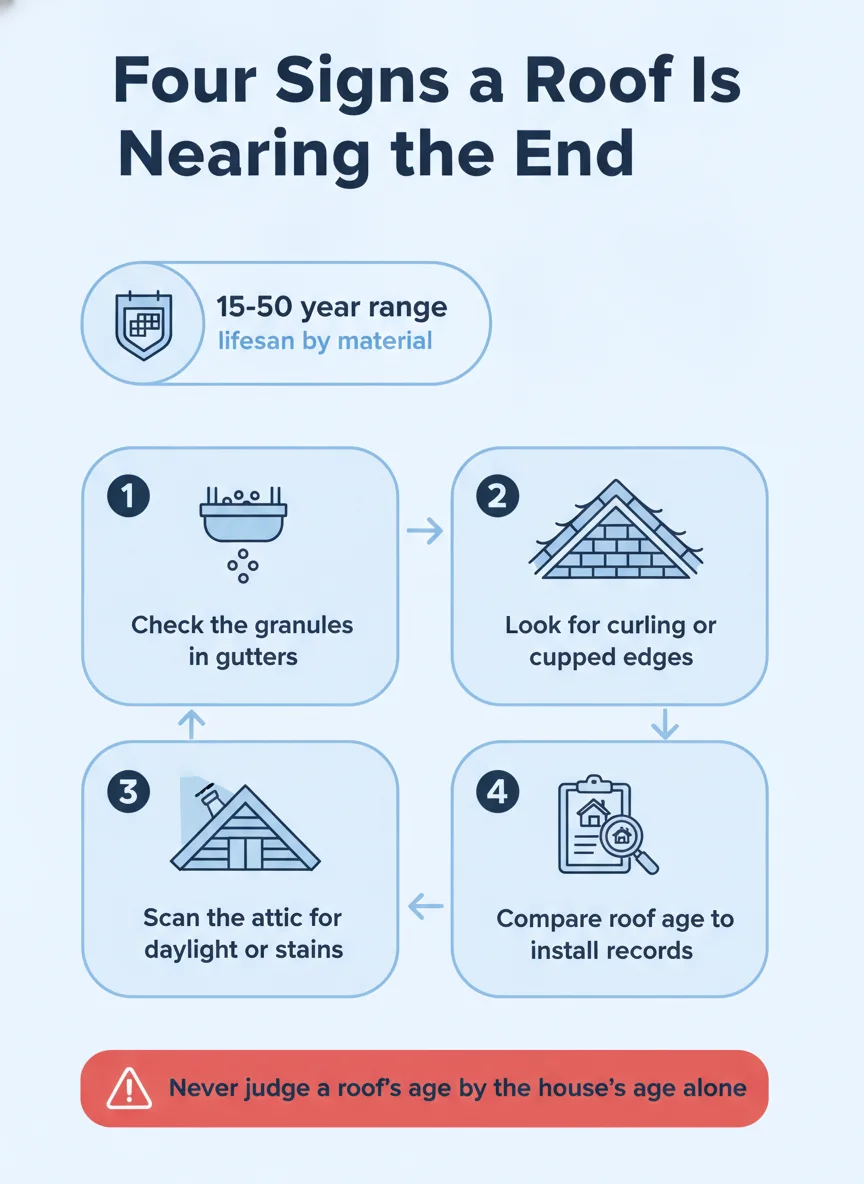
- Find the install date: Check permit records, a prior insurance claim, or ask the previous owner. Don't rely on the house's build year alone.
- Check the gutters: Granule buildup in the gutters or downspouts is a sign the shingle surface is wearing down faster than normal.
- Look from the curb: Scan for curling edges, dark streaking, or spots where the roofline looks uneven or wavy.
- Check the attic: Look for daylight through the decking, water stains, or a musty smell, all signs moisture is getting past the surface layer.
- Note any storm history: A roof that's taken a direct hail or wind hit in the last few years may be further along than its age suggests.
- Compare to the chart: Match your material and age against the typical ranges above to see roughly where you stand.
- Schedule a professional look: A trained eye catches bruising, lifted tabs, and flashing issues that are easy to miss from the ground.
What You'll Typically Find at Each Stage
Early and Mid-Life Signs
A roof in the first half of its lifespan usually shows uniform color, tight granule coverage, and flat, well-seated shingles or panels. Flashing should be snug against chimneys and vents with no visible gaps, and the attic should be dry with no light coming through the decking anywhere.
Minor granule loss in gutters during the first few years is normal as a new roof sheds manufacturing debris, and isn't itself a red flag. What matters more at this stage is catching small issues, a lifted shingle tab, a small flashing gap, before they turn into a leak that shortens the roof's real lifespan.
Late-Life Signs
A roof approaching the end of its range typically shows widespread curling or cupping, bald patches where granules have worn away completely, and streaking that doesn't wash off. On metal and tile roofs, late-stage signs usually show up at the flashing and fastener points rather than across the whole surface.
Inside the attic, late-stage roofs often show staining on the decking even without an active leak, along with visible light at nail pops or seams. At this point, roof repairs can buy time for small issues, but a full roof replacement is usually the more cost-effective path once multiple systems are showing wear at once.
DIY Checks vs. Calling a Licensed Roofer
Homeowners can safely do the ground-level and attic checks described above: looking at the gutters, scanning the roofline with binoculars, and checking the attic for daylight or staining. These give you a reasonable first read on whether a closer look is worth scheduling.
Getting on the roof itself is where it stops being a DIY job. Hail bruising, lifted flashing, and soft decking are easy to miss without training, and walking on an aging roof risks causing damage or getting hurt. A licensed roofer also knows what a normal amount of wear looks like for each material and can tell the difference between cosmetic aging and a structural problem.
If your roof has taken a recent hail or wind event, or if you're buying a home and don't have reliable records on the roof's age, a professional inspection is worth scheduling before you make any decisions either way. It's a quick way to replace guesswork with an actual answer.
Putting the Chart to Use
The ranges in this chart are a starting point, not a verdict. Two roofs of the same material installed the same year can age differently depending on ventilation, installation quality, and what weather they've absorbed since. Use the chart to set expectations, then confirm with an actual look at your roof rather than relying on the calendar alone.
If you're trying to figure out where your own roof stands, whether it's close to the top of its range or has years of life left, Total Building Experts Roofing & General Contractor can walk the roof and the attic with you and give you a straight read on what you're working with.
Frequently asked questions
How long does a roof actually last in Texas?
It depends heavily on material: asphalt shingles typically run 18-22 years in this climate, metal 40-70 years, and tile or slate can exceed 50 years with proper upkeep. Texas sun, heat cycling, and hail all shorten these ranges compared to milder climates.
Does the age of my house tell me the age of my roof?
No, and this is one of the most common mistakes homeowners make. A house built decades ago may have had the roof replaced once or twice since, so always check permit records or ask the seller for the actual install date rather than assuming it matches the home's age.
What shortens a roof's life the most in Texas?
UV exposure and heat cycling do the slow damage, drying out asphalt and breaking down sealants year after year, while hail and high wind cause sudden, visible damage that can cut years off a roof's remaining life in a single storm.
Can I extend my roof's lifespan with maintenance?
Yes, routine attic ventilation checks, prompt repair of small leaks, and keeping gutters clear all help a roof reach the upper end of its expected range instead of the lower end. Neglect is usually what pushes a roof to fail early.
How do I know which stage my roof is in?
A visual inspection from a licensed roofer that checks granule loss, flashing condition, and attic decking will tell you whether you're in the early, mid, or late stage of your roof's expected lifespan, which is more reliable than guessing from the calendar alone.