
A Small Repair Call That Isn't Always Small
Across Central Texas, hail and wind pass through often enough that most homeowners eventually face a small roof problem: a lifted shingle tab, a leak around a vent pipe, a bit of flashing pulled loose at a chimney. It's tempting to call whoever's available, and a general handyman is usually cheaper and faster to book than a specialty roofer.
The catch is that a roof is a water-shedding system, not a collection of independent parts. A fix that looks fine from the ground can leave a gap in that system if it isn't done with roofing materials and technique. Knowing which repairs are genuinely simple and which only look simple is the difference between paying once and paying twice.
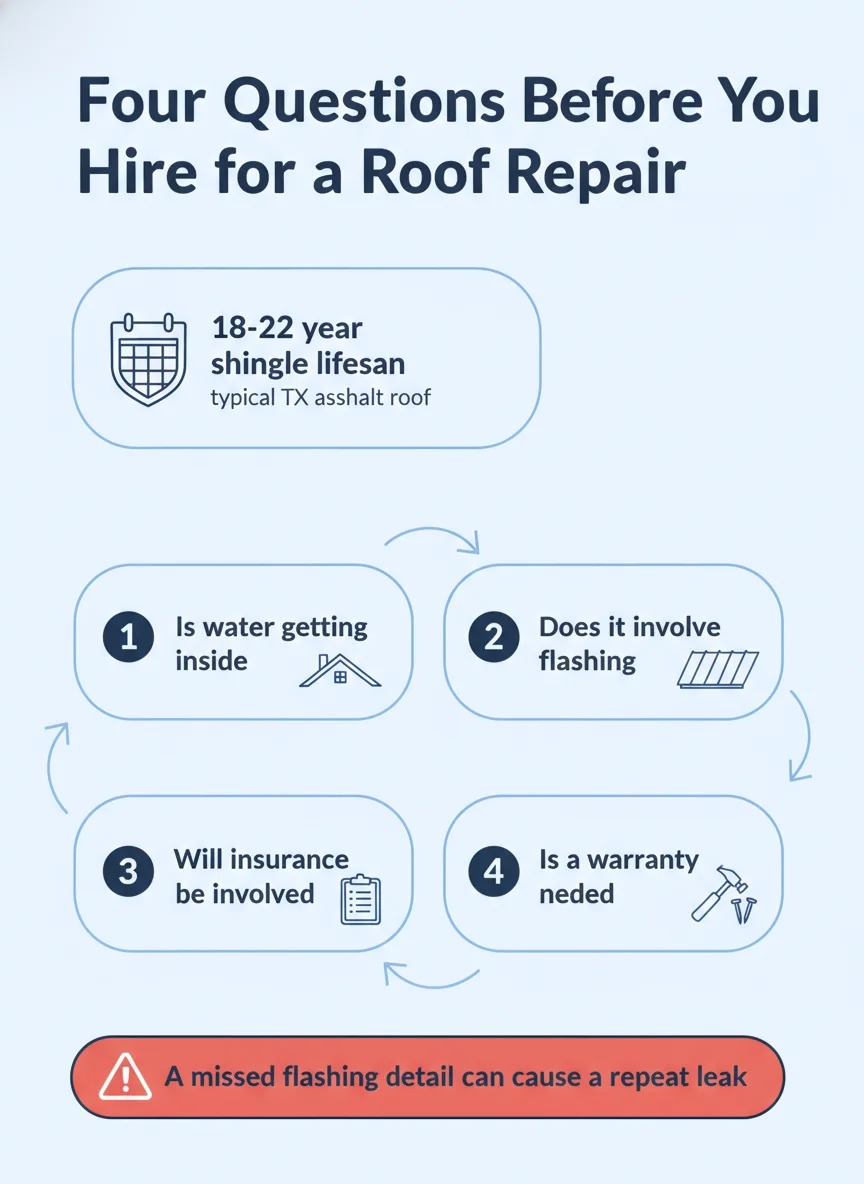
What Actually Separates the Two Trades?
A handyman is a generalist, skilled across many small home repairs but without specialized roofing training. A roofer works on roof systems daily and knows how layers of shingle, underlayment, and flashing are supposed to interact in Texas heat, wind, and the occasional hailstorm.
What a Licensed Roofer Brings
A roofer understands how to match existing shingle color and profile so a repair doesn't stand out, and how to tie new flashing into old without leaving a gap for water to find. Roofers also typically carry liability insurance for work at height and back their labor with a written workmanship warranty.
That matters most around penetrations like pipe boots, skylights, and chimneys, where most leaks actually start. A roofer has seen these failure points enough times to diagnose the real cause instead of just patching the visible symptom, which is the difference between a repair that lasts years and one that resurfaces after the next rain.
Where a Handyman Is a Reasonable Call
For cosmetic or very minor items, a handyman can be the practical choice. Resealing a vent boot that's just starting to show hairline cracks, or replacing a single shingle that blew loose but left the surrounding area intact, doesn't usually require specialized roofing equipment.
The key word is isolated. If the issue is contained to one small, visible spot with no sign of water staining inside, and you're comfortable with the handyman working on a ladder or low slope, it's a reasonable way to save a service call. The moment the problem touches flashing, multiple layers, or anything above a single story, that math changes.
| Factor | Handyman | Licensed Roofer |
|---|---|---|
| Material matching | Limited access to roofing-grade products | Carries or sources matching shingle and flashing |
| Flashing repairs | Usually outside scope | Core part of the trade |
| Warranty on the work | Rarely offered in writing | Written workmanship warranty is standard practice |
| Insurance claim documentation | Not equipped for adjuster meetings | Can document damage and meet the adjuster on site |
The Part of the Roof That Causes Most Repeat Leaks
Flashing is the thin metal, usually aluminum or galvanized steel, installed at every place the roof plane meets something else: a chimney, a wall, a skylight, a vent pipe. It's designed to direct water around that junction instead of letting it pool or seep through the seam.
Flashing failure doesn't always look dramatic. Sometimes it's a nail hole, a sealant bead that's shrunk and cracked, or a step-flashing piece that's slipped a half inch out of position. None of that is obvious from the ground, which is exactly why a leak near a chimney or wall often gets patched in the wrong spot and returns within a season.
Step-by-Step: Deciding Who to Call
Before you book anyone, walk through a short checklist. It takes a few minutes and saves you from hiring the wrong trade for the job in front of you.
- Check for water staining: Look inside the attic or ceiling below the suspected area. Active or old water staining usually means the problem is bigger than the visible surface damage.
- Count the affected shingles: A single shingle or small cluster is a smaller job than a spread-out pattern of missing or lifted shingles across a slope.
- Identify nearby penetrations: If the damage sits within a few feet of a vent pipe, chimney, or wall, flashing is likely involved and the repair needs roofing-specific skill.
- Ask about a warranty: A roofer who stands behind the repair in writing is accountable if it fails. A verbal assurance from a handyman isn't the same protection.
- Consider the roof's age: An older roof nearing the end of its service life may need an honest look at repair versus replacement, not just a patch.
- Think about insurance: If storm damage might be involved, a roofer who can document damage and meet an adjuster is worth more than a lower hourly rate.
What You'll Usually Find When You Look Closer
Repairs That Stay Simple
Some repairs really are what they look like. A single shingle lifted by wind with no cracking, no exposed nail heads, and no staining inside is often a quick, contained fix. These are the cases where a handyman's lower rate and faster scheduling make sense, and the risk of a callback is genuinely low.
The same goes for minor sealant touch-ups on a pipe boot that's otherwise intact. If the boot itself isn't cracked and the shingles around it are undamaged, resealing is a maintenance task more than a structural repair.
Repairs That Turn Out Bigger
Other times, what looked like one loose shingle turns out to be the edge of a wider problem: underlayment that's been wet for a while, a run of nails that backed out across several courses, or flashing that's corroded at the seams. These situations usually aren't visible until someone is physically on the roof checking adjacent areas.
This is also where missing shingles after a windstorm can be a signal of storm damage rather than simple wear, which changes both the repair approach and whether insurance should be part of the conversation.
What You Can Handle Yourself vs What Needs a Pro
Ground-level maintenance is fair game for most homeowners: clearing debris off the roof surface with a leaf blower, checking gutters for overflow, and doing a visual scan with binoculars after a storm. None of that requires climbing on the roof or touching materials.
Anything that involves walking the roof itself is a different category. Asphalt shingles can be surprisingly slick, especially with any morning dew, and a misstep risks both a fall and further damage to the shingles themselves from foot traffic in the wrong spot.
Flashing work, underlayment repairs, and anything tied to a potential insurance claim fall squarely in licensed-roofer territory. A roofer is trained to diagnose the actual failure point, not just patch what's visible, and carries liability coverage for the work that a general handyman typically doesn't carry for roof-specific jobs.
Making the Right Call the First Time
The smartest move for anything beyond a clearly cosmetic fix is to start with a free roof inspection rather than guessing. An inspection tells you whether you're looking at an isolated repair or something that touches flashing, decking, or multiple shingle courses, so you hire the right trade the first time.
Homeowners in Cedar Park and across the region tend to save the most money by getting that honest read upfront instead of layering patch jobs on top of each other. Total Building Experts Roofing & General Contractor handles roof repairs across Central Texas with that same straightforward approach, matching materials and tying flashing in properly so a small repair stays small.
Frequently asked questions
Can a handyman fix a roof leak?
A handyman can sometimes patch a small, visible issue like a loose shingle tab or a bit of exposed nail, but most leaks trace back to flashing or underlayment work that calls for roofing-specific know-how. If the leak returns after a handyman patch, it usually means the real entry point was never found.
Is it cheaper to hire a handyman instead of a roofer?
A handyman's hourly rate is often lower, but cost isn't just the invoice. A repair done without matching materials or proper flashing technique can fail again within a season, so you end up paying twice for the same spot.
Will my roof warranty be affected if a handyman does the repair?
Yes, in most cases. Manufacturer and workmanship warranties typically require a licensed roofer to perform the work, so a handyman repair can void coverage on that section of the roof even if the patch holds.
What roof repairs are safe for a handyman to handle?
Small, low-risk cosmetic items, like resealing a vent boot that's just starting to crack or replacing a single visible shingle, are reasonable for a general handyman. Anything involving water intrusion, flashing, or a slope over one story is better left to a roofer.
How do I know if my roof needs a full inspection instead of a quick patch?
If you've had more than one leak, see sagging, or notice granules collecting in the gutters, a quick patch is probably covering a bigger problem. A proper inspection can tell you whether it's a repair or something closer to [the signs roofers look for](/blog/when-a-roof-is-past-repair-signs-roofers-look-for) before you spend money twice.